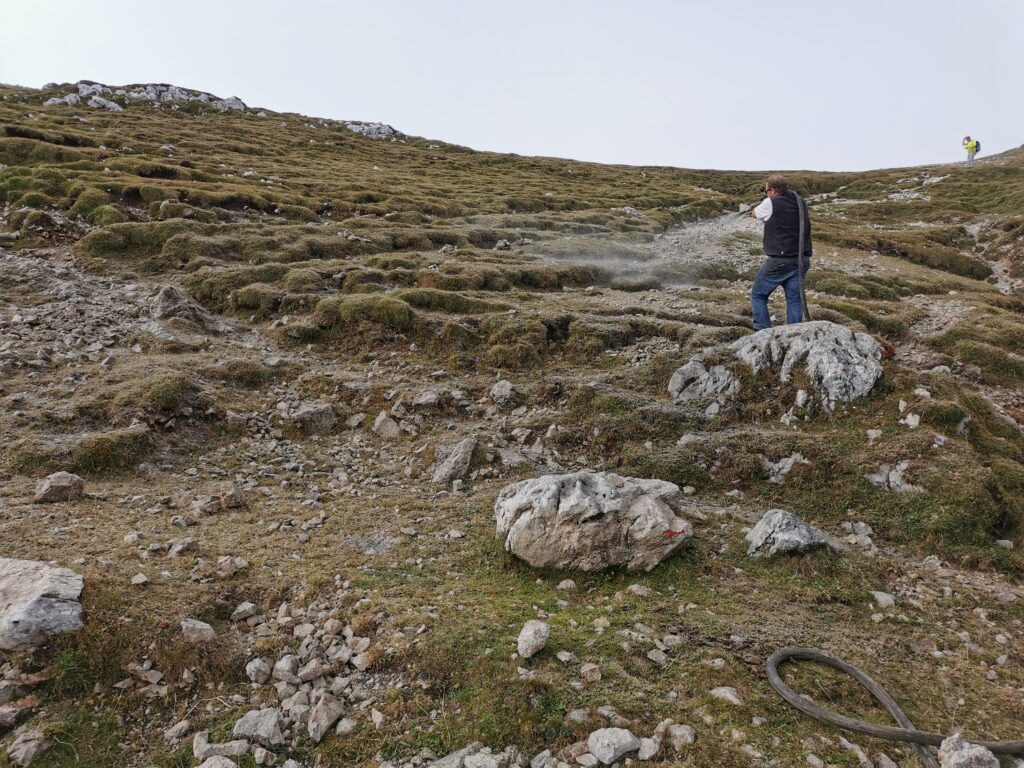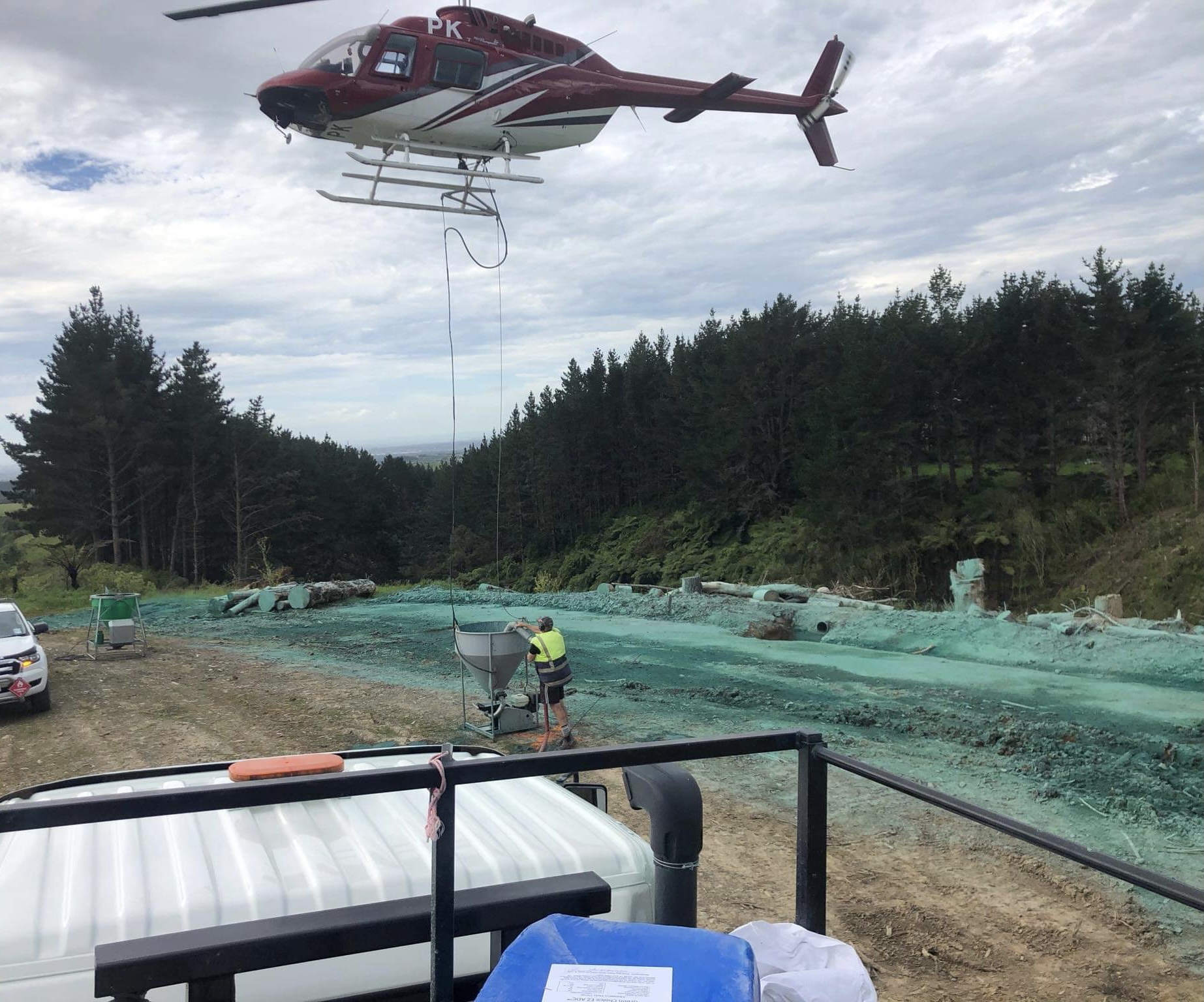
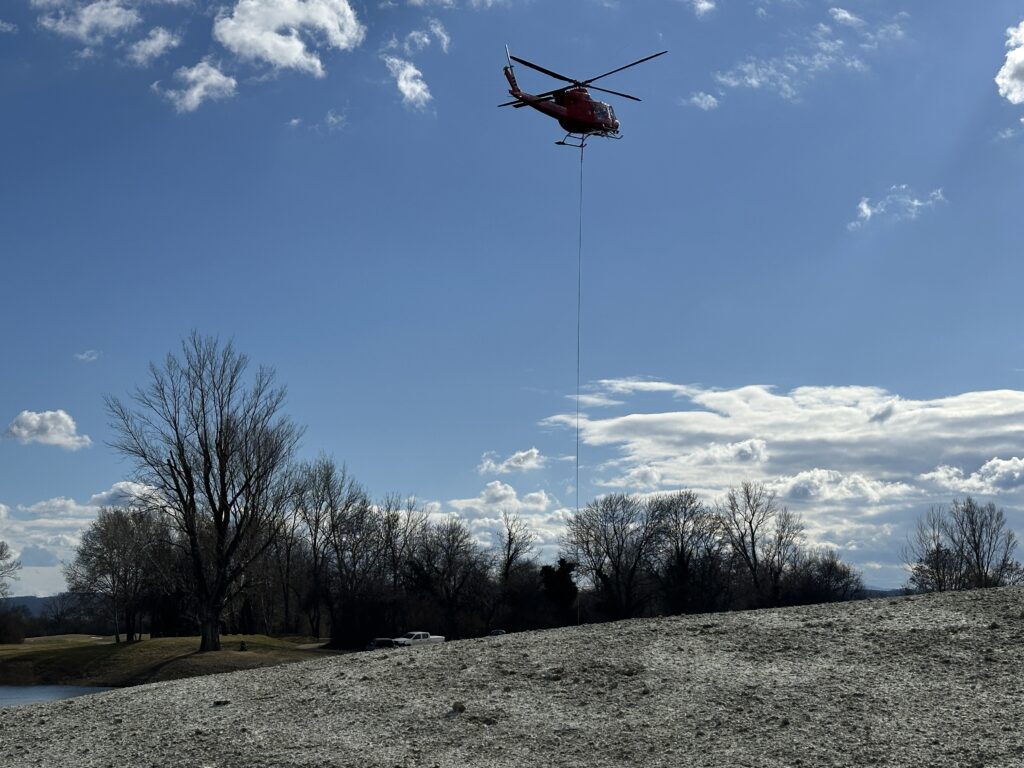
Helicopter seeding extends vegetation establishment to terrain where ground equipment cannot operate — steep alpine slopes, active peatlands, post-fire recovery zones, and ecologically sensitive areas with no access infrastructure. The method requires a fundamentally different engineering approach: payload constraints limit fibre volume per flight, and the matrix must be reformulated to maintain establishment performance with reduced fibre mass.
Standard hydromulch systems rely on fibre volume for performance — water retention, surface adhesion, and thermal buffering are functions of applied mass per square metre. Helicopter operations impose strict payload limits that prevent direct transfer of ground-based application rates.
SRBT's approach uses three engineering levers to compensate: water retention polymers that deliver moisture management at lower fibre volumes; mineral fractions that provide thermal buffering without organic bulk — kaolin for warm-climate albedo increase, biochar for cold-climate albedo reduction; and biopolymer binders that maintain surface adhesion at reduced application rates.
The result is a concentrated mixture calibrated for maximum area coverage per flight while maintaining establishment performance comparable to ground-based systems. Flight planning and pre-application moisture conditions are design parameters, not logistical afterthoughts.
Peatland restoration requires low-nutrient matrices and certified regional seed provenance — conditions incompatible with standard fertiliser-loaded hydroseeding products. Heli-seeding on active peatlands uses formulations specifically designed to support Sphagnum and associated species without nutrient enrichment.
Alpine ecosystems present a different constraint set: 8–10 week vegetation periods, freeze-thaw cycling, and high UV exposure. Application timing is critical — the matrix must deliver immediate thermal and moisture support within a narrow establishment window. Matrix thermal properties are adjusted via the mineral fraction to extend effective growing conditions.
Heli-seeding projects require detailed advance planning: payload calculation, mixture specification, flight window definition, and site moisture assessment. SRBT manages the complete system from engineering concept through execution.